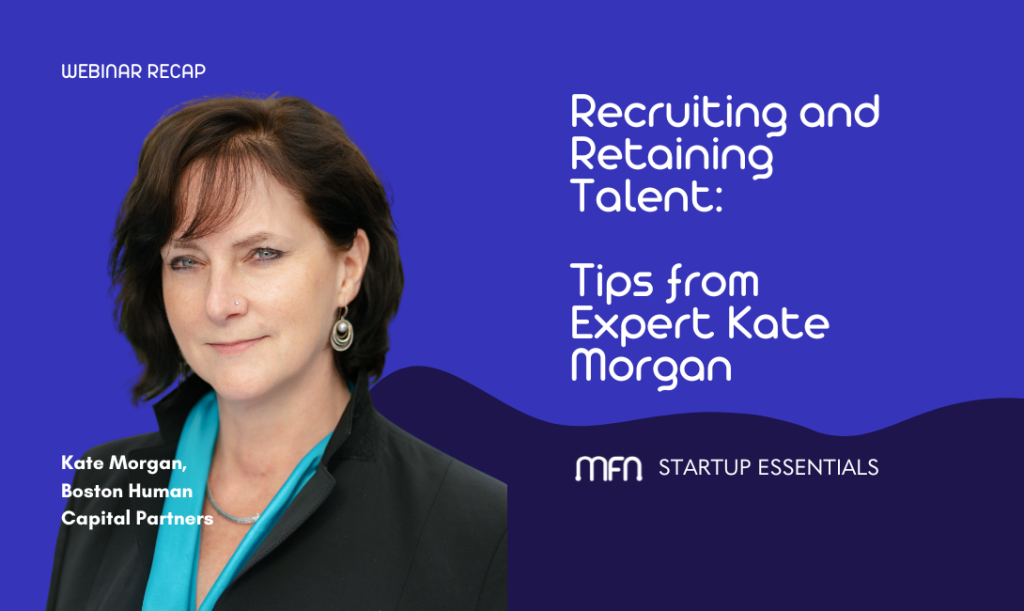
Among the hundreds of tasks startup founders juggle daily, searching for a new team member — and the right team member — can be one of the most overwhelming. Kate Morgan, CEO and founder of Boston Human Capital Partners, and member of the MFN Expert Directory, spoke with MFN about the obstacles early-stage startups face when hiring new talent, and solutions on how to best tackle candidate reviews.
The following is a summary of our webinar with Kate, part of our monthly webinar series available to the Massachusetts innovation ecosystem.
Q: How should startup founders prepare before posting a job opportunity? Is there something in particular they should consider?
Kate: Job descriptions are super, super critical. It’s easy to create a list of responsibilities but you really need a vision of what success looks like 12 to 18 months from now. For example, if you’re hiring an engineer or product manager, write down where they should be at three, six, nine, and twelve months. That gives you a roadmap.
Time and again, we’ve seen companies scale quickly, and six to nine months in, the new hire gets bored. Why? Because the manager didn’t have a game plan for what comes next. The faster a company grows, the harder that becomes. Having that roadmap is crucial.
We recently did a CRO search for a large, established company. I asked two of the company presidents, “What does success look like in 12 months?” They looked at each other and couldn’t answer. That search took two months and ultimately stalled because they didn’t have clarity. You can’t hire based on gut instinct, not at a large company.
Q: If you’re not going with your gut, as you say, what are some strategies that you’d recommend for screening and interviewing candidates?
Kate: A lot of people like the book Who by Geoff Smart. I believe in using scorecards, as the book recommends. But hiring is about two things: skills and culture fit. Founders should define core values they can hire and fire by—values that are practical, not aspirational. One helpful resource is Traction by Gino Wickman. It’s a great tool for distilling your company’s core values.
Once you have those, you can map screening questions to each one. I’ve been playing around with ChatGPT to help draft interview questions based on specific core values and it’s actually really helpful.
And it’s important to remember that startups are scrappy. You’ll likely need generalists, not specialists. Generalists, or “Swiss Army knives”, are essential as roles evolve in a growing company.
Q: Do you have any advice for founders who might be seeking a co-founder? Is that different from hiring an employee?
Kate: Be careful with “friend hires.” Even if you think you’ve found the right person, keep talking to other people. Not everyone marries the first person they date.
Most founders pitch co-founders by excitedly talking about their idea or product. That’s actually off-putting. Instead, lead with curiosity: “Let’s talk about you. I think you might be a fit, and I’d love to learn more.” It makes the conversation more balanced and meaningful.
Also, personalities evolve over time. Just like dating, after six months, you start to see the real person. I strongly recommend using assessments to evaluate behavior, communication styles, and emotional intelligence. These tools validate what you’re already seeing and give you a blueprint for navigating challenges later.
Q: Referrals and reference checks seem to play a big role in startup hiring. Any tips?
Kate: This is my business, but always go to your network first. Your network is going to give you people that they feel like are a really good match for you, because they already know you.
I’m also a big fan of reference checks. If someone gets referred to you, ask why. Treat reference calls as your last line of defense. Say something like, “We’re really excited about this candidate. I want to make sure this is a setting where they’ll succeed.” Then ask specific questions about how they operate and what challenges they’ve faced.
Final Thoughts
If you’re a technical founder, you might look to hire a seasoned CEO. When technical founders stay in the driver’s seat too long, it can limit the company trajectory. Recruiting external leadership isn’t a sign of a failure; it’s a savvy business move, and the pay-offs can be enormous.
But the biggest key to success for startups? Hire people who are motivated by impact and mission.
Are you working to find community and opportunity as a Massachusetts startup founder? Join MFN and get access to experts, networking opportunities, and connections within the statewide entrepreneur ecosystem.