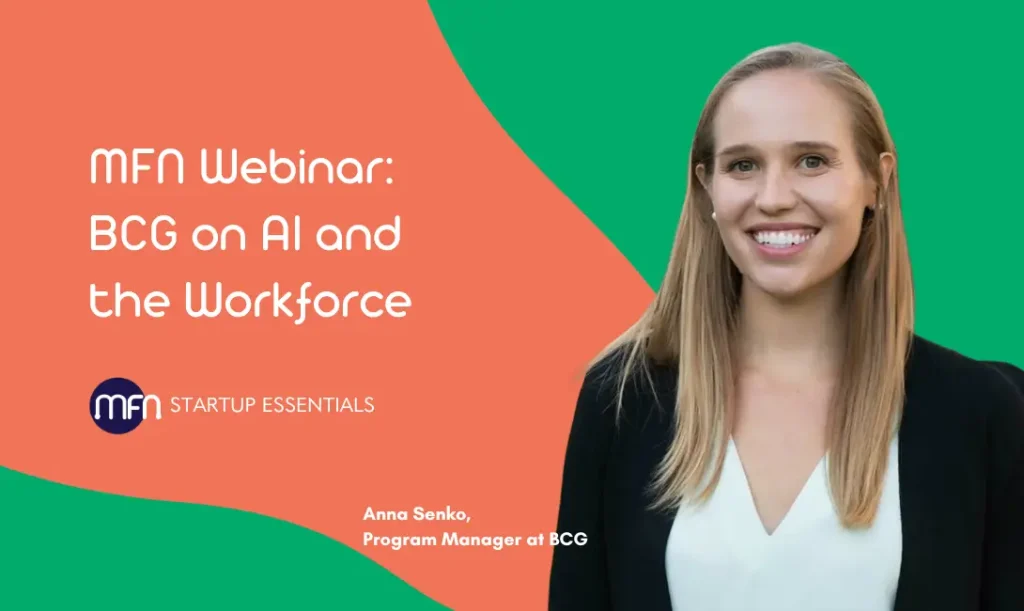
Missed our June webinar? In this discussion, Anna Senko, Program Manager at Boston Consulting Group, shares insights from a recent survey BCG conducted with the Massachusetts Business Roundtable on the state’s readiness within the global AI ecosystem. MBR President and CEO JD Chesloff facilitated the conversation.
Q: Massachusetts has tremendous strengths in AI research and innovation, yet many startups still struggle to scale here. From your perspective, what are some barriers for these companies?
A: If you look at Massachusetts on paper, I don’t think there’s a better place to be. We have the best world-class research institutions and talent in the world. However, there are a few structural obstacles that are holding us back. We retain less talent than California and New York. That ties into the second challenge, the cost of living. That is a significant headwind for founders and engineers.
The third obstacle is commercialization. Massachusetts is so concentrated in early-stage startups, yet we’ve seen that very few actually scale here beyond their series A or stay headquartered here. Finding anchor customers is such a pain point, then procurement burden can be really overwhelming.
Q: Regardless of industry or occupation, what do you think are the most fundamental AI skills every worker should be developing today?
A: AI isn’t going to replace jobs wholesale, but it will replace or heavily influence workers that don’t adapt to using them to using AI. There is a real opportunity for organizations to redeploy workers to focusing on higher value work with the productivity savings of AI. I see things happening in two buckets. One bucket is technical skills. The second bucket is the human capabilities around AI. These are things that AI can’t do on its own: judgment, emotional intelligence, leadership, and communication. I often give the example to my associates that each of us can have the same instructions for the same task, but we get very different outputs.
To close this gap, MBR is helping to create an AI skills guide focused on four clusters:
- AI Literacy – Understanding AI concepts
- AI Insight – How do you apply AI tools to real decisions?
- AI Workflow Design – Integrating AI into your internal system
- Digital and Data Competence – Working effectively in an AI environment
Q: 80 percent of MBR members are accelerating AI implementation. For founders developing innovations based on AI technology, are there opportunities they should be aware of?
A: If you don’t have an anchor customer, then I recommend thinking about how your startup can go deep rather than go broad. Massachusetts has world-class domain expertise in life sciences – climate tech, robotics, advanced manufacturing, etc. Ecosystem stakeholders believe the most interesting opportunities are where AI intersects with these sectors.
In my experience, the mandate typically has been that founders need a certain amount of revenue to be onboarded as a supplier. That’s just not feasible for an early-stage startup. Another avenue is big companies sharing data responsibly. A huge challenge founders face is access to real-world, high-quality data sets. That brings us back to talent retention. Employers can help entice talent to stay in Massachusetts through co-ops and apprenticeships.
Q: If we are sitting here three years from now and Massachusetts has become the nation’s leader in applied AI, what would we have done right?
A: It’s cracking the commercialization and skills gap problems. Having resources such as the MFN Life Science AI Challenge program scale into permanent recurring infrastructure would be absolutely huge. This can create a culture shift where anchor employers in Massachusetts actively pull startups in, rather than startups waiting to be found. This would help a founder in 2029 choose Boston over New York.
Interested in learning more about the BCG and MBR survey results? Access the full survey here.
The new MFN Life Sciences AI Challenge is produced in collaboration with MBR and funded by the Massachusetts Life Sciences Center (MLSC). The program was developed in part based on extensive interviews with leaders across the pharma, biotech, and consulting industries. You can learn more about the cohort here.