
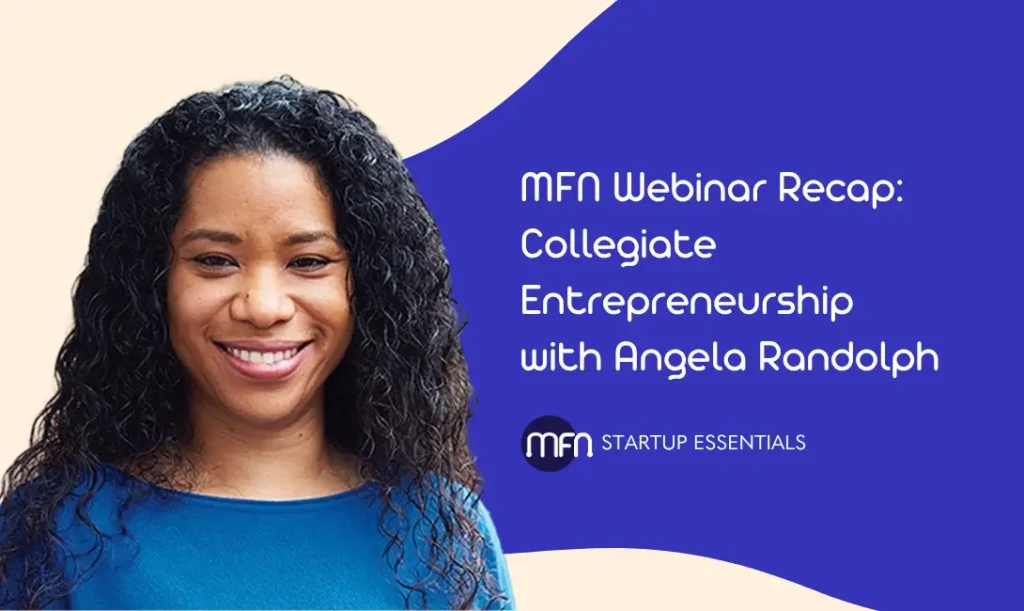
Angela Randolph, Associate Professor of Entrepreneurship at Babson College, recently spoke to our startup community as part of the MFN webinar series. Angela provided firsthand insights into Babson’s distinctive approach to entrepreneurship education, the resources available to aspiring student founders, and her own journey.
Missed the webinar? Check out our recap!
MFN: For those who don’t know you, please introduce yourself and share a little bit about your background.
Angela: I’m now in my 11th year at Babson College as an Associate Professor of Entrepreneurship. It’s funny because I never imagined I would end up here. My undergraduate degree is in chemical engineering, and I chose that path for very practical reasons. At the time, people would say, “If you like math and science, you should be an engineer,” and it was also one of the higher-paying fields.
As I moved through the program, I started to realize I had a growing interest in psychology, but I was too stubborn to change majors, so I stuck with it. Looking back, I’m glad I did, because the process-oriented mindset I developed still influences my work today.
After graduating, I moved more into industrial engineering and worked at Pepsi in operations and production. After a few years, I felt ready for something different, so I went back to school for my MBA, where I focused on finance and marketing. That led me to a career in banking.
During the Great Recession in 2008, I used that as an opportunity to reset. I had a cyber cafe that ended up being more of a gaming center, before you could have Wi Fi in your house.Going through that whole process and working with entrepreneurs as a banker was always something of interest. I used it as a wonderful opportunity to leave banking and think about what I want to do with my life. After my master’s degree I decided to pursue a PhD. I knew I wanted to study entrepreneurship, and I wanted to explore it through the lens of psychology.
After completing my PhD, I came straight to Babson. If you’re interested in entrepreneurship, there’s no better place to be, and it’s been an incredible experience ever since.
MFN: In the work that you do at Babson, what are the things that give you the most gratification? What really energizes you?
Angela: I love working with entrepreneurs. This has always been my favorite part of what I do. Even before becoming an academic, I was working with entrepreneurs in different ways. At one point, I did consulting, primarily on the finance side, but what I’ve always enjoyed most is helping people start and grow their businesses. Just seeing that success for me is the high point.
One of the highlights for me is working with students. Just last week, a student called me and they were so excited because they had just won their very first pitch competition. It came with a small cash prize – but, more importantly, it validated their idea. It was that moment of, “Wow, we did it. This works.” That kind of experience reinforces everything they’ve been learning. These students put in an incredible amount of time and effort on top of their coursework, and it’s amazing to see that dedication pay off.
I also have the opportunity to work with great organizations like Lever, the parent organization of MFN, that are making a real impact. I often think about how I can support others who will go on to have an even greater impact themselves.
MFN: Tell us a little more about the Babson community and the students.
Angela: Babson is a small, close-knit community, about 2,800 undergraduates and 1,100 graduate students, but with a global reach through programs that support entrepreneurship education worldwide.
All undergraduate students study business, but entrepreneurship is woven throughout the entire curriculum, not just one concentration. That starts in the first year, when students are required to launch and run a business as part of a course. They work in teams, manage real operations, and ultimately donate any profits to a nonprofit after repaying their startup funding.
Sometimes students may opt to take their Organizational Behavior and Entrepreneurship courses in two different semesters, but entrepreneurship is a requirement for every student. We also have a lot of co-curriculars around entrepreneurship.
MFN: How does the Babson experience for students impact their future trajectory as entrepreneurs?
Angela: One of the most rewarding things is hearing from former students who continue building the businesses they started at Babson. We see a strong rate of students pursuing entrepreneurship after graduation – around 10 percent go on to run ventures full-time, which is significant. Beyond that, many continue working on their ideas alongside other careers.
Babson supports this through both curriculum and co-curricular programs that help students launch, grow, and connect with mentors and resources. Just as importantly, students are encouraged to try, fail, and learn in a supportive environment. They leave with both experience and a framework for building something of their own.
MFN: What’s your take on the state of collegiate entrepreneurship writ large? How are we doing as a society, as educators? What are the bright spots? What are the areas that need more help?
Angela: That’s actually complicated. Part of what we have to think about is, “Why do we care about students learning entrepreneurship,” right? Most students aren’t going to start a business. Even if it’s taught in the way that you’re trying to help them develop a growth mindset. Creativity, adaptability, and being able to find and use resources are things that are relevant everywhere and in every profession.
One of the upsides of collegiate entrepreneurship is that it provides a sense of community. Entrepreneurship is lonely, so knowing other students becomes important, and then they influence each other. Providing access to networks, access to maker spaces, access to capital, or maybe networks that have capital in them, are things that colleges do well. Some more than others, since all aren’t resourced the same way. But what colleges can do in general is provide experimentation in a safe space. A lot of entrepreneurship is about trying things and seeing what works and what doesn’t. There is a geographic difference in what’s available in the ecosystem in an urban versus a rural area, and that tends to make a difference. We tend to see a lot more men than women in entrepreneurship. We don’t see as much racial and ethnic diversity as we would like. There’s a whole conversation we could have on just that.
The other big thing is there’s a huge focus on tech entrepreneurship and what can be VC-funded. If we think about entrepreneurship, only 3 percent of ventures are actually VC-funded, while the other 97 percent have to find funding elsewhere. So helping students focus more on lean startup and bootstrapping could actually make a big difference, because that’s how most startups start. That is a big focus at Babson. It’s not just, “Can you get funding or not?” We do have a lot of students who do, but we start with a similar process of, “What resources do you have in the moment, and what can you do with that to get to the next step?”
Are you working to find community and opportunity as a Massachusetts startup founder? Join MFN and get access to experts, networking opportunities, and connections within the statewide entrepreneur ecosystem.