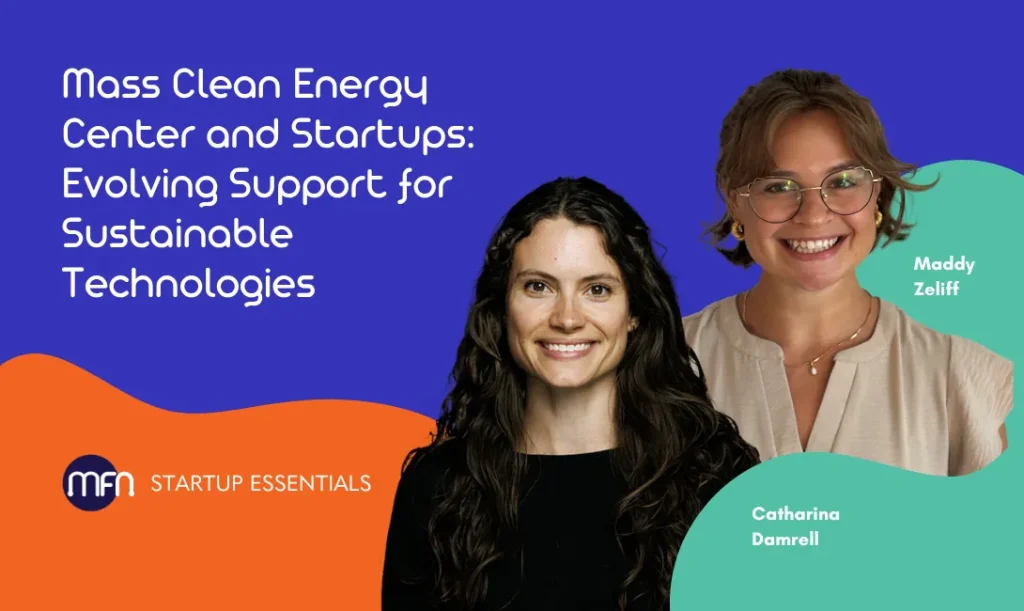
MFN recently spoke with Catharina Damrell, Program Manager of Tech-to-Market, and Maddy Zeliff, Senior Program Manager, at the Massachusetts Clean Energy Center (MassCEC). Their team sits at the center of the state’s efforts to fund and grow early-stage climate technologies. Our discussion focused on how they’re supporting startups in the climatetech ecosystem.
MFN: How did you join MassCEC?
Maddy: I graduated in May 2020 from UMass Amherst as a sustainable management major, so I knew I wanted to be in the sustainability realm. I started at MassCEC in a temp position. I’ve since been a program coordinator, then a program manager, and now a senior program manager, so I saw a lot of growth within the team!
Catharina: I have an environmental studies undergraduate degree, and recently completed a master’s in environmental management at Yale School of Environment in 2024. This MassCEC position caught my eye because it was at the intersection of private sector, climate action, and public support – actually implementing the policies that can help drive climate action. It was a natural fit.
MFN: For founders new to the Massachusetts climatetech ecosystem, what does the Tech-to-Market team do?
Catharina: The Tech-to-Market department sits within the Emerging Climatetech division of MassCEC. We provide non-dilutive funds to startups and researchers across the state, which are essentially grants for entrepreneurs and academics who have an idea or technology that can contribute to the state’s clean energy transition and the climatetech sector.
Our programs are designed to address common challenges that early-stage climatetech startups face. Many of these technologies involve physical systems, which makes them more capital-intensive and riskier to develop compared to software.
Maddy: One of the biggest things we offer is flexibility. We can take risks on companies that traditional investors might not be ready to back yet. That early support can go a long way. It helps validate the technology, gives founders momentum, and signals to future investors that there’s real interest.
Catharina: We’re helping to de-risk these technologies. Climatetech often requires significant upfront investment before it’s ready for commercialization, so having that early support can be critical.

Screenshot of MassCEC Emerging Climate Tech Funding Opportunities chart.
Source: MassCEC
| Company Stage | Program Name |
| Early-Stage | Catalyst/DICES |
| Stage Agnostic; helps fulfill cost-share/adder requirements on other awarded grants | AmplifyMass |
| Pilot Project-ready Stage (i.e. MVP) | InnovateMass |
| Late Stage/For Mature Businesses | Critical Mass |
MFN: Your portfolio programs include CriticalMass, InnovateMass, AmplifyMass, and Catalyst/DICES. What is the typical audience that you see for each program?
Catharina: The way that we’ve structured our funding programs is to mirror the life cycle of a climatetech company. Catalyst/DICES, which stands for Diversity and Climatetech Early Stage, is our early-stage prototyping grant program, and we use the technology readiness level (TRL) rating system as a way to map our funding (see chart above). Those grants are for very early stage – either startups or even academic researchers who are looking to build out a prototype, usually at TRLs 2 through 4.
AmplifyMass is focused on supporting academic researchers and startups in leveraging external funding and bringing that into the state. AmplifyMass is a way for companies and academic researchers to apply for large grants from the federal government, other state governments, or private foundations, and then our program comes in to amplify that funding and can help folks with their cost-share requirements on those grants.
Maddy: We often see folks go from Catalyst/DICES and AmplifyMass to InnovateMass and really use that time to grow their company and get more funding.
CriticalMass is usually for bigger teams at mature companies that are almost fully commercialized and able to scale. At that stage, they’re doing a larger deployment project that’s basically full-scale and used with a project partner as well.
MFN: What feedback are you getting from climatetech founders who have secured funding through these programs and have implemented the grants?
Catharina: For a lot of the Catalyst/DICES grantees, we ask for feedback. I would say, 90 percent of participants say something to the effect of this is a critical grant moment or funding moment for their startup and idea. Without it, they wouldn’t have been able to get as far as their beachhead target customer. So having the ability to really build out that prototype and prove that it’s working is critical.
Tech-to-Market is one aspect of our Emerging Climatetech division. We have an actual investment team, and there is also the business development team. The business development team is small but mighty, and they interact with all of the different Massachusetts quasi-state agencies. It’s been immensely helpful for early startups to be able to get tapped into the state and start to understand, “Okay, if I need to build out a bigger prototype, I need this kind of manufacturing capability. Where can I find those manufacturers?” We’re able to give a much more holistic white-glove service to the founders who use our programs. It’s much more than being awarded just the dollar amount.
MFN: Anything else MFN members and other folks in the startup community should know?
Maddy: We want companies to grow here! We are always here to listen and brainstorm – and connect you with the right people if we’re not the right people. We’re here to be supportive.
Catharina: Definitely check out our programs! And, if you have an inkling that you might want to apply to any of them, then please reach out and we can set up a time to chat.