

Electric vehicles (EVs) are the future — but when it comes to charging infrastructure, many communities in Massachusetts need better solutions to make the transition work for them.
As interest in electric vehicles rises throughout the region, infrastructure to support that growth isn’t keeping pace. Current approaches to EV charging (Level 2 and Level 3 DC Fast Charger stations) rely on high-voltage systems designed to provide quick and easy battery charging capabilities, attempting to replicate the gas station model.
However, many communities still rely on electrical infrastructure built before EVs were invented. Buildings constructed even as recently as 20 years ago require major upgrades and overhauls to accommodate the voltage capabilities of modern EV charging stations. High installation costs — which can lead up to several hundreds of thousands dollars per unit — limit the much-needed proliferation of EV chargers.
“It’s a chicken and egg problem,” notes Ross Bloom, founder and CEO of Somerville-based startup Revvit. He explains that consumers can’t switch to EVs if their communities don’t offer adequate charging capabilities. However, property owners lack the incentive to install these stations when EV users remain a small minority.
Ross’s company, Revvit, is grounded in a scrappy solution: working with what’s available. He suggests that the solution to EV scalability isn’t about charging speed, but about simplicity.
Revvit’s chargers utilize 120-volt connections, just like a laptop or a lamp. But they offer an improved charging speed and experience compared to the typical Level 1 charging cables that come with some EVs. The low electrical requirements of these chargers make them a more scalable and inexpensive way to deploy EV infrastructure. Installation can cost less than $1,000 per unit — up to 90% lower cost than Level 2 chargers.
While this lower installation cost comes with a trade-off of a slower charging speed, Revvit’s Level 1 chargers are specifically designed for circumstances in which cars already sit for long lengths of time (office buildings, apartment complexes, airports, etc.). In addition to working with property owners, Ross says Revvit is also focused on building partnerships with public housing authorities, state agencies, and other community institutions to drive further impact.
By intentionally choosing a slower, simpler charging method, Ross believes Revvit will help expand EV access to communities currently underserved by the clean transportation movement. He hopes this big bet will pay off by bridging existing industry gaps, making it easier for EVs to integrate wholly into public life.
Ross is currently focused on building up EV infrastructure in Western Massachusetts, where clean energy interest is high but grid capacity is low. Although Ross himself is a Boston-based entrepreneur, he recognizes the need for statewide collaboration on clean energy solutions and has focused on expanding Revvit’s efforts across the state. The western half of Massachusetts faces clear, structural barriers to matching the charging infrastructure availability of the eastern part of the state and Revvit sees an opportunity to fill some of those gaps.
To that end, Revvit recently launched the 413 Charger Challenge — an initiative to install 413 chargers across the 413 area code that covers much of Western Massachusetts. In a partnership facilitated by Lever (MFN’s parent organization), Ross will partner with woodcrafters in Western Massachusetts to construct these new chargers using local, sustainably harvested wood. This effort reflects a deep commitment to ensuring the project’s infrastructural impact aligns with local aesthetics and economic development goals.
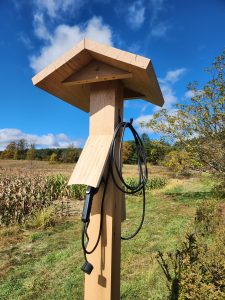
With the 413 Charger Challenge and other initiatives, Ross hopes to demonstrate the value of convenience and community mindedness in boosting EV charging access. “Sometimes, a simpler solution is actually a more sustainable one,” he notes.
Are you working to find community and opportunity as a Massachusetts startup founder? Join MFN and get access to experts, networking opportunities, and connections within the statewide entrepreneur ecosystem.