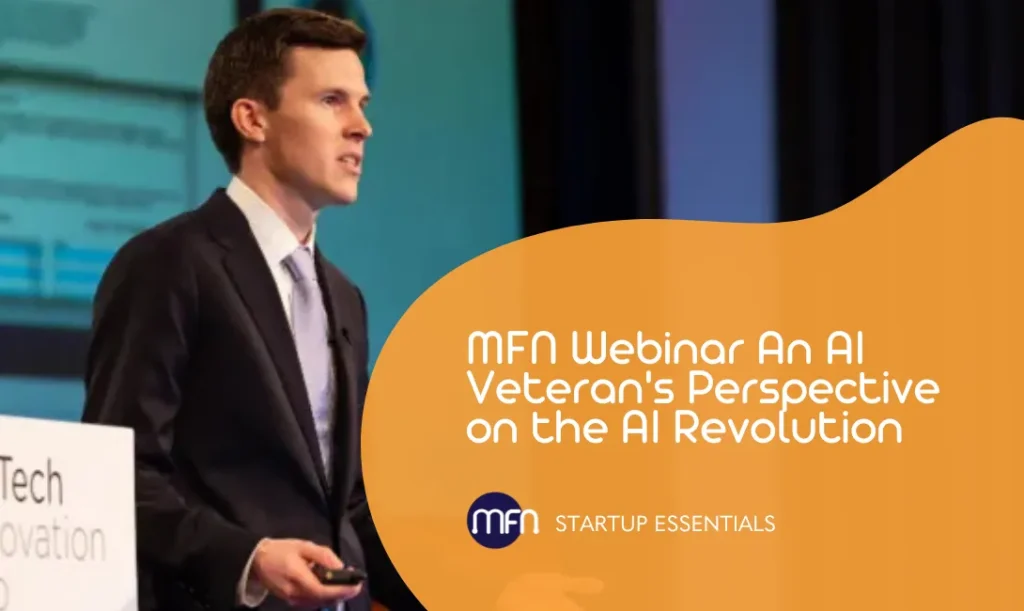
In this conversation with MFN, Jason Briggs, Senior Vice President of Agentforce Applications at Salesforce AI, shares the story behind his first startup, what it was like building AI tools before ChatGPT existed, and why today’s startup founders have more power than ever to build better, iterate faster, and compete with giants.
MFN: How did your journey into AI begin?
Jason Briggs: It actually started at Williams College. I saw a poster for a business plan competition that (Lever Executive Director) Jeffrey Thomas was running, and I decided to enter. My idea came from watching my mom struggle with way too many files on her desktop and never finding what she needed.
To help with that, I built an app called Tidy Pro in Xcode. It showed you a big preview of your file on one side, suggested likely folders on the other, and let you quickly clean up your desktop. It was my first real AI product, simple but useful.
We pitched Tidy Pro in the business plan competition in the summer of 2015 and got third place. After the event, an alum approached me and offered to invest if we could match his amount with other local investors. So we started pitching everyone we could. That process forced us to refine the idea, and it evolved from Tidy Pro into Meta.
The new concept was: even if you organize your files, you still can’t find them. So we decided to build the world’s best search engine for personal content by automatically tagging every file across Google Drive, Dropbox, Slack, Trello, Evernote, and your desktop using what we called “smart tags.” Essentially, it was Google for your own files.
MFN: Where did the process go from there?
Jason Briggs: We built a prototype, raised about half a million dollars, and moved to Boston to make it real. We were lucky to have built a truly high-quality, scalable product early on. Thousands of people used it, and we had a lot of investor interest. The challenge was, no one wants to pay for search. We have users that love the product, but they didn’t want to pay for it. So we were trying to pivot into enterprise.
One of my advisors, who had founded a company building AI research agents for enterprise customers, suggested combining efforts. They had the customers and deep AI research experience. We had the product. So we merged, and that became Diffio.
Diffio built “AI research assistants” before anyone was talking about AI-copilots. Our system analyzed what users were writing and then automatically ran searches across the web and internal data. It surfaced related documents, citations, and insights in a sidebar next to your work.
For example, if you were writing about a company, it might show you that they had a factory you didn’t know about and suggest adding that to your report. It wasn’t perfect as these were pre-Large Language Models (LLM) but it worked well enough to attract serious enterprise customers.
Eventually, the CRM-software company Salesforce acquired us. They were interested in embedding our AI technology into their platform to enhance how users interacted with data. We joined Salesforce just two months before COVID, and for three years I led Einstein Relationship Insights, which was essentially Diffio for Salesforce.
MFN: Do you ever think about how starting a few years later might have changed your outcome?
Jason Briggs: All the time, but mostly in the opposite direction. I’m grateful for how things turned out. There were multiple points when we almost ran out of money, and something always intervened just in time.
Timing is a huge factor. The market has to be ready for what you’re building. If we’d started a few years later, we might have been positioned like Glean, which is exploring some of the same ideas we had at Meta. Back then, the technology just wasn’t there yet and users had to dig through false positives and incomplete results.
But starting too late is risky too. And, now, building foundational AI products is incredibly expensive. The inference costs alone can be 70 to 80 percent of a company’s expenses. Unless you have deep pockets, like the major tech firms, you’re constantly fundraising just to stay afloat.
Applied AI products (those that use APIs from OpenAI, Anthropic, or Gemini) are a different story. Those can still be built by smaller teams. But for companies trying to train or fine-tune their own models, the costs are staggering.
Get more of Jason’s perspective on AI Tools by checking out our previous profile here. Interested in other AI tools available to startup founders? Check out the MFN AI Tools for Startups, a catalog of AI-based platforms used by MFN members to help manage everything from accounting needs to taking notes during meetings. Suggest an AI resource to add!