

Parker Smith, a rising third year student at Davidson College, interned at Lever where his job was to perform market research supporting several cleantech startups from Lever’s network. Before wrapping up, he took some time to reflect on how he used AI in that work, highlighting particularly helpful tools. Here’s Parker…
In my work at Lever, I used AI research tools as an autonomous research partner. Instead of pulling surface-level sources, these tools performmulti-layered, sequential research that emulates the process of a human analyst. I employed Google’s Gemini, Anthropic’s Claude, and OpenAI’s ChatGPT, which all have designated deep research modes.
The strength of AI research tools lies in their ability to simultaneously draw from multiple sources: the web, images, documents, code, and more. Additionally, tools with access to your work email and documents can cross-reference external market data with your own business records, constructing an exhaustive and contextualized analysis specific to your company.
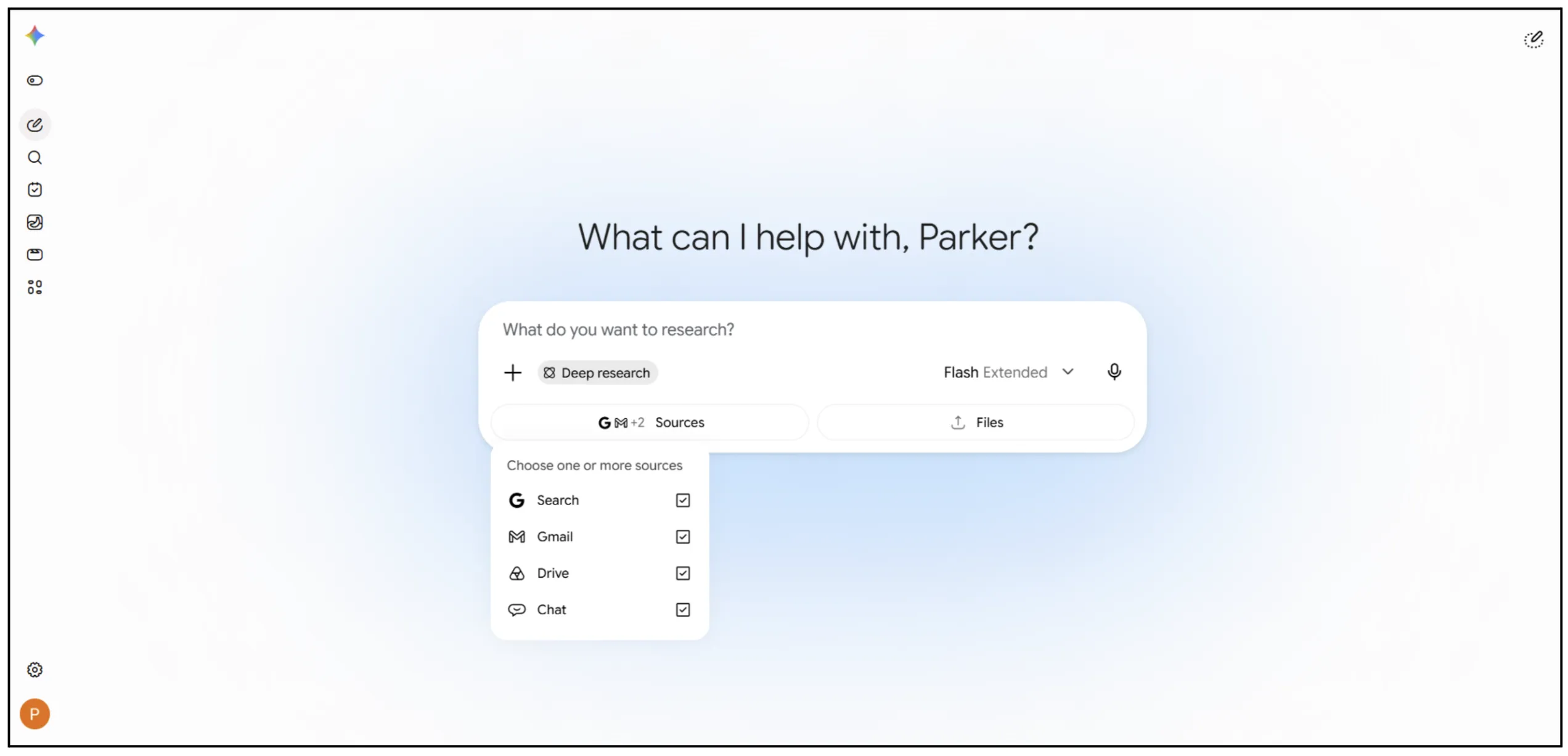
To get the best result, you need a structured approach centered on three critical pillars: prompting, iterating, and validating.
1. Prompting: Giving the right information
An unspecific chatbot prompt gives you standard results. For in-depth business analysis, your initial prompt should establish explicit boundaries, clear metrics, and specific targets.
When outlining your research, clearly define your parameters:
- Target Entity: Name specific companies, narrow sub-sectors, or geographical regions rather than asking for general industry trends.
- Valuation or Financial Benchmarks: Request precise financial metrics like compound annual growth rates (CAGR), typical EBITDA multiples for specific markets, or historical pricing tiers.
- Structural Constraints: Tell the tool exactly what to ignore. For example, explicitly ask it to filter out billion-dollar transactions if your strategy focuses entirely on small-to-medium businesses; utilize verified industry data and SEC filings rather than generic blog roundups and unsourced market aggregators; or exclude market data and regulatory frameworks outside of the United States.
2. Iterating: Perfecting the output
Unlike AI engines that generate a single response, deep research tools set a research agenda before completing the final report. This is where you actively steer the direction of the research.
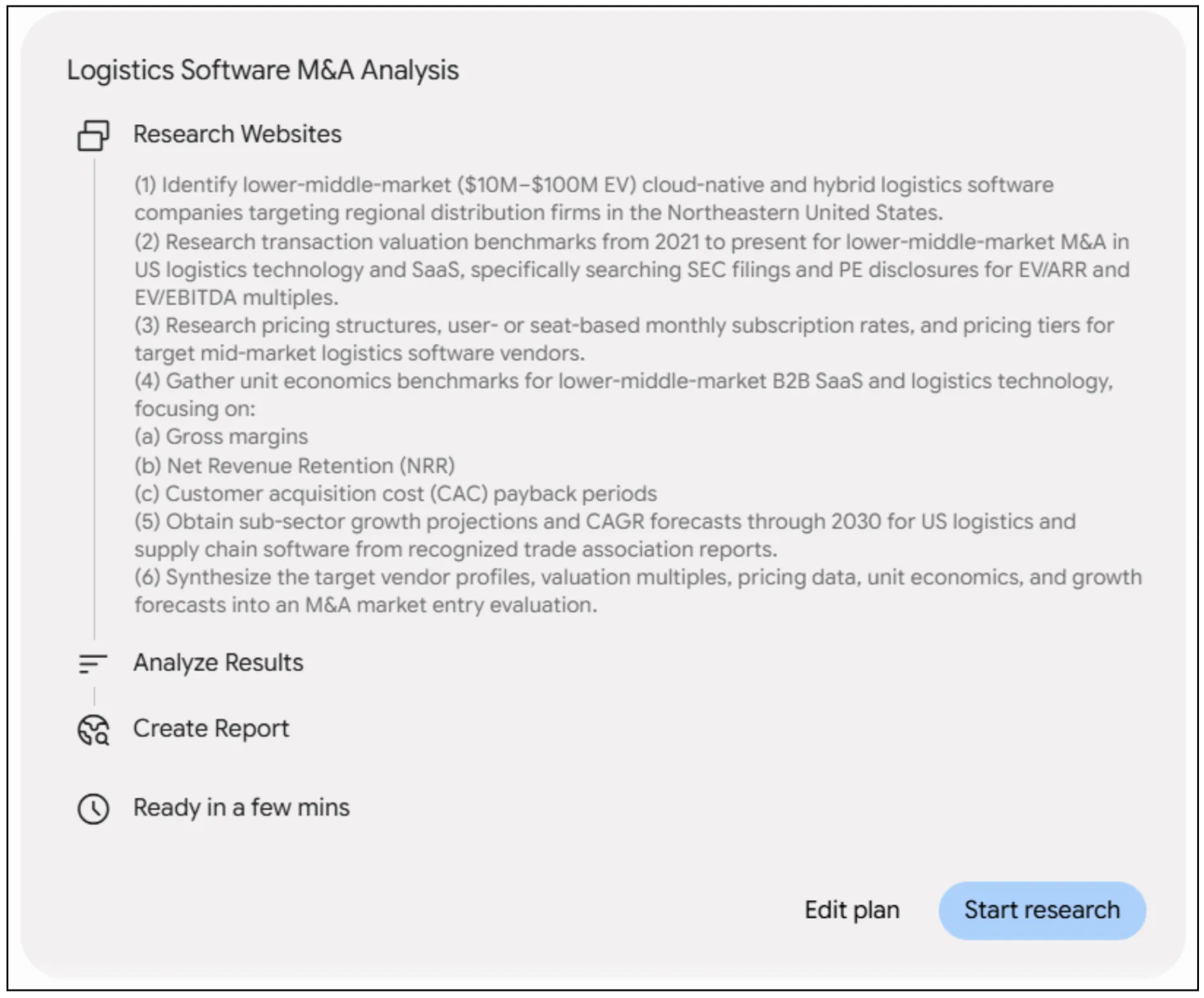
Once the initial report is completed, strengthen the output by further refining the scope. If the initial search returns a large volume of generalized data, iterate by narrowing the lens to specific operational models—such as shifting focus away from capital-intensive manufacturing lines to light, tech-enabled recurring software services. Treat the tool as a professional peer; refine its output and direction as new data points emerge.
3. Validating: Checking sources and citations
While AI has come a long way, it still makes mistakes. Before you make use of a deep research tool’s output, always check its reasoning.
The final output of a deep research task is heavily annotated with inline citations and direct source links.
- Analyze the Citations: Click through to verify that data, white papers, or financial charts map back to credible, primary sources.
- Check the Timeline: Ensure the tool hasn’t blended historical data with current real-time market realities.
- Reconcile Internal Data: If you’re utilizing a chatbot with access to your email and work documents, check for sensitive information before distributing your research to others. It is up to your company’s discretion to determine which data to share with a chatbot as pertaining to data privacy.
By understanding this cycle of thoughtful prompting, deliberate iteration, and careful validation, teams can transform raw web traffic into high-grade market intelligence in a fraction of the time.