
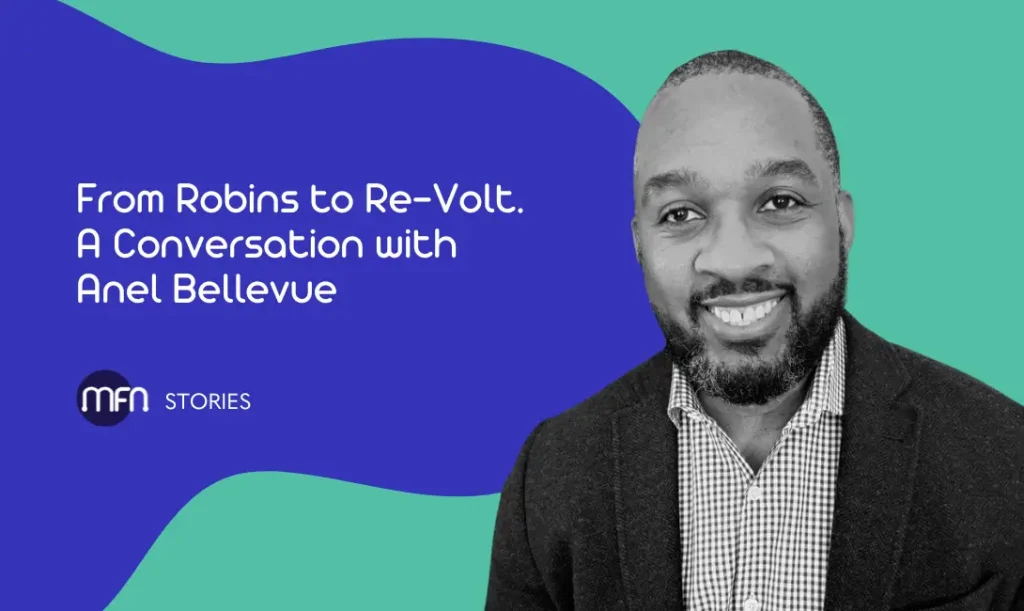
Anel Bellevue is the co-founder and CEO at Re-Volt Charging, a Massachusetts-based climatetech startup that’s working to increase equitable access to EV charging infrastructure. Bellevue was a member of the Climate Panel at the Mass Black Expo in October.
Can you share the story behind founding Re-Volt Charging and what the company means to you?
Re-Volt Charging was grown out of two forces: a deep commitment to community, and recognition of the urgent need for equity access to clean energy. Far too often, people assume that if you drive an EV, you have to be in a high income bracket, so therefore let’s not install EV chargers in underserved communities. That’s a huge misconception and we found it to be completely false. The use of EV’s has become widespread, especially used EV’s. But access to charging remains unaffordable and inaccessible to many.
For me, Re-Volt is more than a company. It’s a vehicle for impact – creating infrastructure that just doesn’t serve early EV adopters, but ensures everyone benefits from the transition equally.
Your undergraduate degree was in Kinesiology, on a pre-med track at UMass Amherst. Seventeen years later you went back to school, this time to study Business Administration and Management at Bentley University. What brought you to business school?
I actually started by studying American robins as a biology major. I was involved in deep research, studying how birds come up with the sounds they make, also called their repertoire. At some point early on I transitioned to exercise kinesiology with a pre-med track, but later realized med school was not my calling.
I ended up launching a fitness company, which took an early dive early on in the pandemic, and I had to make an honest decision about my career trajectory. Our controller once asked: “Have you ever thought of getting your MBA to sharpen your business skills?” I said, “Sure, why not?” It only took one class at Bentley for me to fall in love with the curriculum.
A follow-up: Do you feel as though your science background has contributed to your work as an entrepreneur?
It actually does. One thing science taught me is to allow things to be tested and have a tolerance, an appetite for being wrong. You learn to deal with – and expect – the unexpected.
Also, if you think about it, I started working with birds, transitioned completely to human anatomy and physiology, and now I’m on the other side – learning a whole different language on how to do business, infrastructure, and clean energy. I think I have a real appreciation for learning.
As the founder/co-founder of multiple companies in Massachusetts, what resources or organizations have helped you along the way?
I’ve been very fortunate to be part of a very supportive ecosystem here, with organizations like the Massachusetts Clean Energy Center, BEC MA and The National Black MBA Association. We also have a partnership with the McKinsey & Company’s Connected Leaders Academy. As part of Lever, we’ve had the opportunity to work with Jeffrey, Natalia, and Avril, which is just a priceless resource. And, of course, the academic environment at Bentley, Northeastern, and WPI gives us the chance to test ideas with students, professors, and mentors.
Founders don’t build in isolation. Community is critical.
Do you have any advice for first-time founders?
Founders need to be focused, clear about their mission and very resilient. The journey is never linear. As you heard from me, my journey has not been linear at all. You’ll face more nos than yeses, so you have to have a tolerance for rejection. But if you are clear why you are building something, and you are willing to adapt without losing sight of that purpose, you’ll find traction.
Are you working to find community and opportunity as a Massachusetts startup founder? Join MFN and get access to experts, networking opportunities, and connections within the statewide entrepreneur ecosystem.