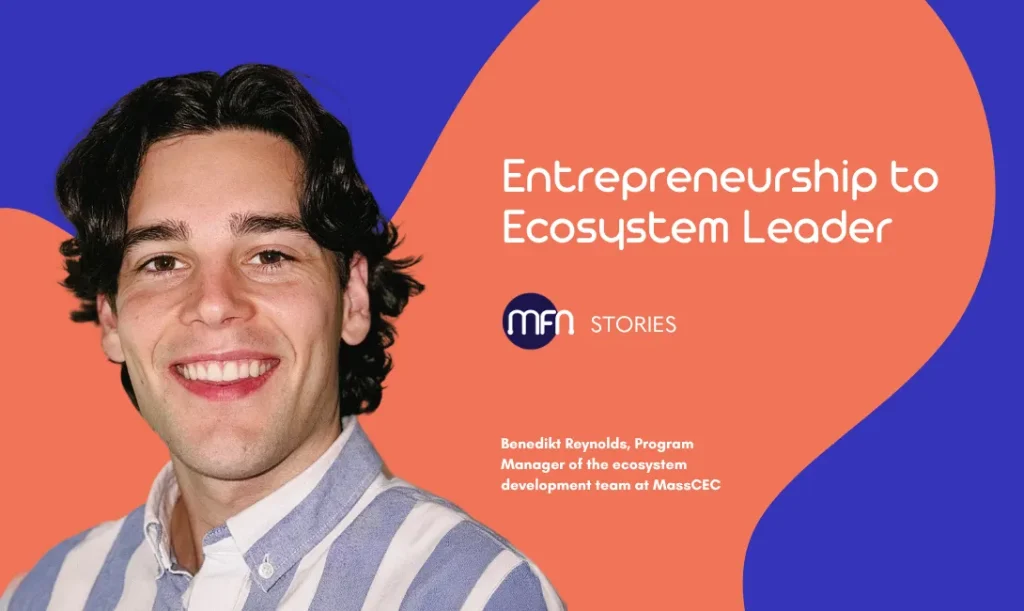
Benedikt Reynolds is Program Manager of the ecosystem development team at Massachusetts Clean Energy Center (MassCEC), which supports early-stage climate technology companies and provides grants to accelerators, incubators, and other entrepreneur support organizations. Prior to this role, Benedikt had his own startup journey. He spoke with MFN about his experience as a founder and how that has influenced his approach to guiding startups.
MFN: What sparked the idea to build your own business? What were some of the challenges you faced?
Benedikt: I had a startup called Boyfriend, and we made modern products for couples, specifically focused around emotional and sexual intimacy. The idea stemmed from a void my friends and I felt for what we called “positive masculinity” — essentially having it be okay for men, especially straight men, to talk about intimacy with their partners. It was a very fashion minded business. We started with luxury loungewear for couples, as well as a question card game for couples to play to create that intimate space. We also partnered with other small businesses and provided a variety of date night and cocktail kits. Boyfriend was a direct-to-consumer e-commerce business, so not what you and I typically work with now.
I think overcoming the taboos around masculinity and intimacy and trying to mass market our product were always going to be difficult. The team’s strengths were that we had a very efficient product development pipeline. We were able to come up with ideas, prototype them, and get them out in the market pretty quickly. But I think the area that we needed the most work on was, once you create the widget, how do you market it? How do you find the target consumers, and so forth. While we did our product development process, we made sure to include stakeholders in that the entire way. But we continued to run into: “How do we market this thing so that we’re not spending advertising dollars inefficiently?” Or: “How do we tackle this topic in a friendly and fun-loving way, rather than turn people off of it?” That was one challenge.
A second challenge was just our marketing stack in general. We were so focused on product development, trying to figure out what was the right way to go about this – influencers, tabling events, traditional Facebook and Instagram ads – took a significant amount of time and effort. Then, lastly, I was 23 or 24 when I started the company and it lasted three years, so there were a lot of limits to my own leadership. We don’t exist anymore, but we had three great years.
MFN: After that chapter closed, why did you want to stay in Massachusetts and continue to be in the innovation community?
Benedikt: I have always wanted to work in the public sector in some way. My background is in computer science and design, and I originally thought I might go to grad school for urban design. But a friend working at MassCEC encouraged me to consider a different path in helping design startup programs and policy instead. That opportunity really clicked. I could apply my entrepreneurial experience in a public sector role while still doing creative, design-oriented work.
What I’ve observed is that Massachusetts is one of the best research and development hubs in the world. There’s a strong university ecosystem, access to venture capital, and a highly talented workforce with a lot of passionate people. I think if you surround yourself with people who want to change the world, then that might rub off on you.
I have had the opportunity to live in so many different places, such as Kansas, Louisiana, Texas, Rhode Island, Ohio, Michigan, and Germany. The list goes on, and I’ve found that you really don’t know what is unique about a place until you leave it. There was a time when I left Boston, and I was surprised at how the environment here isn’t found just anywhere. Hopefully that validates sticking around for anyone who considers leaving!
MFN: How have the skills from your startup experience been an asset to you in your role now in startup support?
Benedikt: I think it’s just being able to relate to startups. I mentioned product development a couple of times – knowing what it’s like to build something new with your hands, and to iterate on it, thinking about it day and night. In meetings or the design process for new grant programs for startup opportunities, it’s helpful to have someone at the table who can say, “Actually, I think startups would be reacting very differently to this,” or “We need to refrain from this.”
As cliché as it sounds, I’ve been where those founders are. I think it’s very similar to the instance where you’re in college, or you’re working somewhere new, and then you bump into someone in the cafeteria, and you ask them where they’re from, and you realize that you’re from the same place. You bring up that popular diner, unique landmark, or something culturally specific and the other person instantly understands and you can relate to each other.
MFN: What advice would you give to a first-time entrepreneur or an early-stage startup founder at the beginning?
Benedikt: When I was a startup founder, I spent a lot of my time on my laptop working on a lot of digital assets, such as e-commerce stores, marketing, and so forth. I didn’t spend enough time going to casual pitch-a-thons or founder happy hours, joining accelerators, and meeting people. Now that I’m in this job, and it’s my responsibility to go to these events, meet entrepreneurs, hear their questions, I realize: “Wow, I wish that when I was in their shoes, I was doing this.” So getting out there to share your idea, connecting in-person with people across the ecosystem – it’s an old-fashioned notion but still true. I would say make a consistent effort to get out of the house and check out all kinds of events, even if it’s just for fun. People like me, investors, venture capitalists, etc. attend too!
Check out what’s happening throughout Massachusetts by visiting the MFN Events Calendar! Hosting a networking event or specialized workshop? Submit your event for other founders to learn more and register!